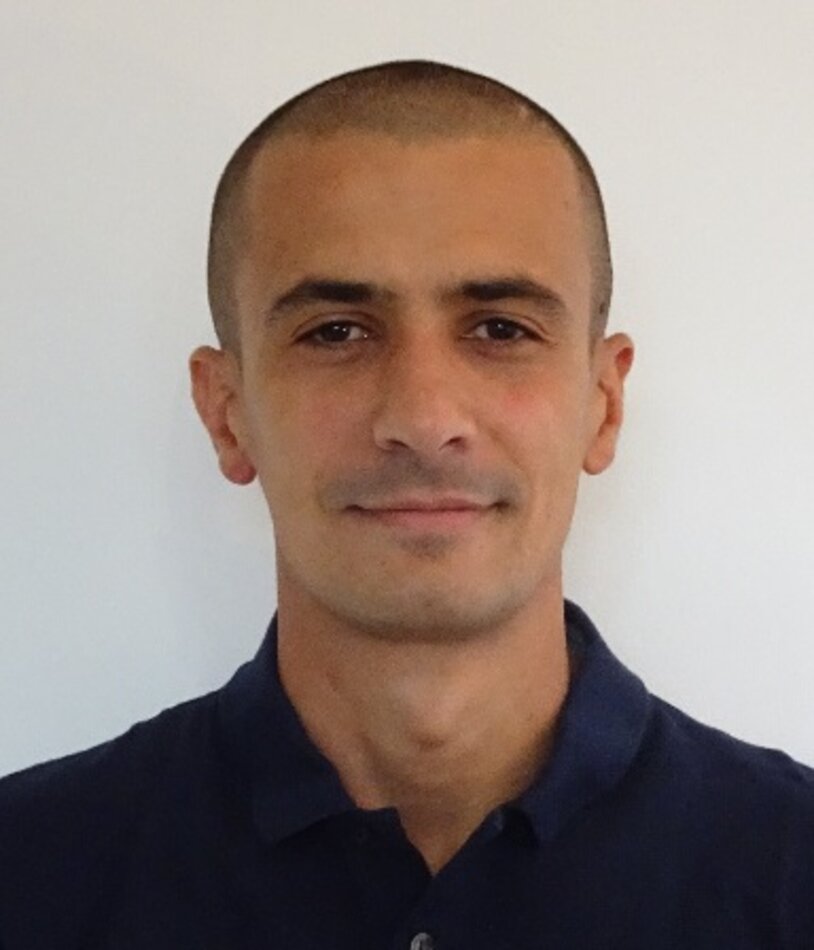
Doctorant en STAPS Mention "Sciences sociales du sport"
PRAG
matthieu.stioui@univ-amu.fr
06 64 94 75 72
Faculté des Sciences du Sport de Marseille
163 avenue de Luminy Case 910, 09e arr.
13 288 Marseille Cedex 09
Doctorant en STAPS Mention "Sciences sociales du sport"
PRAG
matthieu.stioui@univ-amu.fr
06 64 94 75 72
Faculté des Sciences du Sport de Marseille
163 avenue de Luminy Case 910, 09e arr.
13 288 Marseille Cedex 09
J’ai été enseignant d’EPS certifié puis agrégé près d’une dizaine d’années en collège, lycée et lycée professionnel avant d’être recruté en tant que PRAG à la Faculté des Sciences du Sport de Marseille en 2016. Mes enseignements portent essentiellement sur la formation aux concours EPS ainsi que sur les activités de boxe en milieu scolaire, thématique à propos de laquelle j’ai proposé des publications dans des revues professionnelles. Je fais parti du jury de l’agrégation interne EPS depuis 2024. Depuis 2022, j’ai entrepris une activité de recherche portant sur la mesure situationnelle de la littératie physique ainsi que sur les interventions l’impactant favorablement.
Le QPE4PL : un outil situationnel pour mesurer la qualité perçue des leçons d’EPS et son impact sur les dimensions de la littératie physique perçue.
Université de Strasbourg, sous la direction de Christophe Schnitzler (Jury Christophe Schnitzler & Lisa Lefèvre), 2024, mention très bien.
Titre : Impact d'une éducation physique de qualité multiniveaux sur la littératie physique du lycéen
Directeur de thèse : Christophe Schnitzler
Co-encadrante : Lisa Lefèvre
Résumé de la thèse :
Ma recherche porte sur la construction d’une intervention multi-niveaux d’une EPS de qualité à la fois à l’échelle de la leçon et de la vie d’un établissement scolaire pouvant impacter positivement la littératie physique chez un public lycéen.
11 publications
Matthieu Stioui, Lisa Lefèvre, Cédric Roure, Oguzhan Aksoy, Christophe Schnitzler
Frontiers in Psychology, 2026, 17, ⟨10.3389/fpsyg.2026.1876341⟩
Article dans une revue
Introduction: Existing physical literacy (PL) assessment tools primarily evaluate enduring traits and provide limited insight into students' immediate experiences during physical education (PE) lessons. This study aimed to develop and validate the QPE4PLimpact, a questionnaire designed to assess the situational impact of PE lessons on high school students' PL. Grounded in a monist and phenomenological perspective, PL was conceptualized as an embodied and contextual construct encompassing physical, psychological-affective, cognitive, and social domains. Methods: Questionnaire development followed a three-phase process involving (1) domain identification based on existing theoretical frameworks and expert consensus, (2) item generation and refinement via expert feedback and cognitive interviews, and (3) psychometric evaluation with exploratory and confirmatory factor analyses. Results: The analyses supported a four-factor, 19-item structure with good reliability and satisfactory evidence of construct validity. Discussion: The QPE4PLimpact provides a theoretically grounded and pedagogically relevant instrument for assessing the immediate, context-dependent expression of PL in PE lessons. It offers new opportunities for evaluating educational practices and supports future cross-cultural and longitudinal research.
Matthieu Stioui
Enseigner l'EPS, 2025, 298, pp.19-22
Article dans une revue
Matthieu Stioui, Lisa Lefèvre, Christelle Trio, Christophe Schnitzler
Movement & Sport Sciences - Science & Motricité, 2025, ⟨10.1051/sm/2025004⟩
Article dans une revue
This scoping review aims to identify the impact of educational interventions on physical activity levels and physical literacy in Europe. Using the bioecological model, we analyzed the effectiveness of interventions in increasing engagement in physical activity and examined their impact on the dimensions of physical literacy. Our results show that 10 of the 12 selected articles focus on the microsystem (PE lessons) and/or the mesosystem (school-family relationship). The analysis highlights motivation as a predominant target, positively influencing physical and cognitive aspects. The remaining two articles were multilevel interventions, more fully utilizing all dimensions of the bioecological model, and were more successful in increasing weekly physical activity. However, their impact on physical literacy, which lays the foundation for a long-term active lifestyle, remains unclear. We recommend developing intervention research according to the UNESCO framework by creating multilevel and multi-stakeholder interventions to promote physical literacy in schools and establishing cohorts for long-term evaluations. This could improve PE teacher training by raising awareness of effective strategies to promote active lifestyles.
Matthieu Stioui
EPS : Revue education physique et sport, 2023, 398, pp.62-64
Article dans une revue
Matthieu Stioui
Enseigner l'EPS, 2023, 290, pp.23-25
Article dans une revue
Matthieu Stioui
Enseigner l'EPS, 2022, 286, pp.29-32
Article dans une revue
Matthieu Stioui, Laurent Bois
EPS : Revue education physique et sport, 2018, 381, pp.70-72
Article dans une revue
Matthieu Stioui, Ivan Riollet
L'élève lycéen en EPS : Approfondir son expérience dans 23 APSA, 89, Revue EPS, pp.249-259, 2020, 978-2-86713-594-1
Chapitre d'ouvrage
Matthieu Stioui, Lisa Lefèvre, Keith Davids, Christophe Schnitzler
14ème Biennale de l’ARIS : Vers une éducation physique et des pratiques d’activités physiques et sportives durables : enjeux, défis et perspectives, ARIS, Jul 2026, Montréal, France
Communication dans un congrès
Matthieu Stioui, Lisa Lefèvre, Camille Schittly, Christophe Schnitzler
13ème Biennale de l’ARIS : Innovations dans les pratiques d’intervention en éducation physique et en sport, ARIS, Jul 2024, Lausanne (CH), France
Communication dans un congrès
Matthieu Stioui, Lisa Lefèvre, Cedric Roure, Christophe Schnitzler
2026
Pré-publication, Document de travail
This study reports the development and validation of the QPE4PLimpact, a questionnaire designed to assess the immediate impact of physical education (PE) lessons on high school students’ physical literacy (PL). Grounded in a monist and phenomenological view, PL is conceived as an embodied, contextual construct encompassing physical, affective, cognitive, and social dimensions. Addressing a gap in existing tools focusing on enduring traits, the QPE4PLimpact captures students’ situational perceptions post-lesson. Its development involved a three-phase process: (1) domain identification through a Delphi consensus, (2) item generation and refinement via expert feedback and cognitive interviews, and (3) psychometric evaluation with exploratory and confirmatory factor analyses. Results supported a four-factor, 19-item model showing good reliability and construct validity. The instrument offers a theoretically grounded and pedagogically relevant way to assess the dynamic, context-dependent nature of PL, with implications for future cross-cultural and longitudinal research.