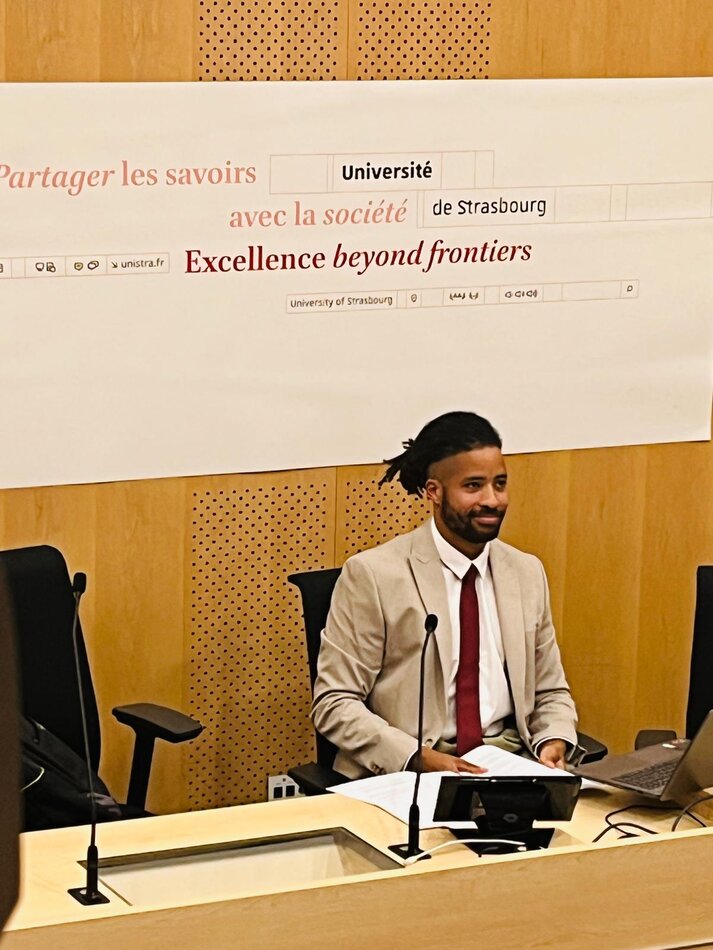
ATER
aj.gateau@unistra.fr ou jean.gateau.g[at]gmail.com
06 84 98 76 76
Bâtiment "Le portique"
14 rue René Descartes - 67084 Strasbourg Cedex
ATER
aj.gateau@unistra.fr ou jean.gateau.g[at]gmail.com
06 84 98 76 76
Bâtiment "Le portique"
14 rue René Descartes - 67084 Strasbourg Cedex
Récemment docteur diplômé de l’Université de Strasbourg, Adrien Gateau s’intéresse aux approches sociologiques et organisationnelles du sport. Spécialisé dans la question des sports urbains – et tout particulièrement le parkour qu’il pratique depuis près d’une dizaine d’années – ses travaux interrogent l’émergence et la diffusion des pratiques communément décrites comme « nouvelles », « atypiques » ou « urbaines » à travers les jeux des acteurs qui les structurent.
Mémoire de Master
LE PARKOUR : VERS L’EMERGENCE D’UNE PRATIQUE ET D’EQUIPEMENTS SPORTIFS NOVATEURS. L’exemple strasbourgeois du Tracespace de Hautepierre
Université de Strasbourg, sous la direction de Michel Koebel, 2019.
Thèse de Doctorat
Titre :Les transformations du parkour par ses réseaux : l’illustration du renouvellement et de l’institutionnalisation des sports urbains en France
Directeur de thèse : Michel KOEBEL
Résumé de la thèse :
Activité physique « jeune », le parkour, jusque-là caractérisé comme « sport urbain », se structure aujourd’hui sous la forme d’associations, de fédérations – voire même de fédérations internationales. Cette thèse s’intéresse donc aux réseaux et aux acteurs au centre de ces processus « d’institutionnalisation ».
2 publications
Robin Lesné, Adrien Gateau, Sidney Grosprêtre
International Journal of Sport Policy and Politics, 2026, pp.1-23. ⟨10.1080/19406940.2026.2722907⟩
| Publiée le 27 août 2026
Article dans une revue
Parkour is a lifestyle sport that originated in the Parisian suburbs in the 1990s. It has sparked research in various fields, with studies examining either the activity itself or using it as a stage to discuss broader or relatively distinct topics. As no systematic review of the scientific literature on parkour has yet been conducted, and as parkour is considered as an urban sport, this paper provides a quantitative analysis of the provenance, authorship, themes, and conclusions of 107 papers focusing on the research theme of ‘Parkour and Urban Space’. Although the topic appears to generate less academic interest nowadays, our study reveals that sociological perspectives are prevalent, with a tendency to use parkour to study broader social phenomena rather than the activity itself. Additionally, we observe a linguistic and cultural ’endogamy’ in the references that authors draw on. Finally, we categorise seven lines of enquiry into three groups: the socio-spatial construction of the individual, inter-individual relationships, and societal norms; transformations in space analysis through parkour as a situated, playful, and interactive practice with space; and parkour as a philosophical object, which is less grounded in empirical research. Although our study exclusively compiles papers from the humanities field, further interdisciplinary work is suggested in addition to the existing natural sciences, technology, engineering and medicine research on parkour. Ultimately, parkour offers fresh perspectives on conventional research topics and provides practical insights into current and future urban planning trends.
Adrien Gateau, William Gasparini
Journal of Borderlands Studies, 2024, ⟨10.1080/08865655.2024.2394066⟩
| Publiée le 28 août 2024
Article dans une revue
Using the example of sport, this article proposes to analyze border spaces as geographical and relational territories which are constructed and institutionalized by connecting national systems, public policies, stakeholders and representations. After a brief summary of the emergence of the sporting ideology promoting a competition area without borders, we will illustrate our argument based on our analysis of the Franco-German border area constituted as a European Grouping of Territorial Cooperation (EGTC), i.e. the Strasbourg Ortenau Eurodistrict (EDSO). Examples of cooperation and shared sporting activities show that sport is an area of cross-border public action capable of creating Franco-German exchanges and raising the subject of bringing together residents from both sides of the Rhine. However, the field investigation also shows that creating events that bring different populations together is not enough for cultural exchanges to take place.
TD L1 Sociologie du Sport (2019-2020)
TD L2 Sociologie du Sport (2019-2020)